
SKU: PRE-S6
UPC: 673454002281
Linked to MusiPos
RRP: $1117.64
Stock:
0 — Primary Warehouse
0 — Secondary Warehouse
Description
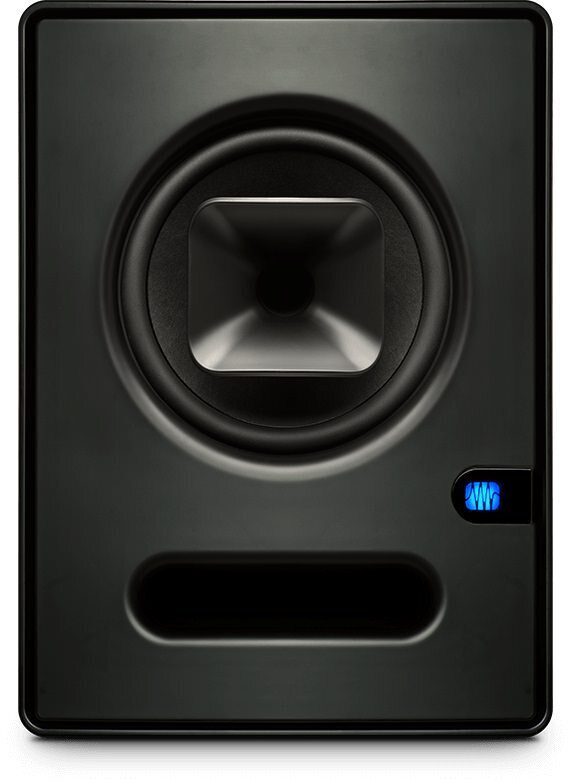
Sceptre High-Definition CoActual Active Studio Monitor
Sold as a single speaker
The sceptre (or scepter) is the age-old symbol of royal authority. PreSonus Sceptre CoActual studio monitors do indeed provide sound quality and control worthy of the highest levels of aristocracy—but they’re priced for the bourgeois project-studio owner.
The first time you hear Sceptre-series CoActual™ 2-way studio monitors, you’ll discover fine nuances of your music that can’t be reproduced by conventional designs. The Sceptre’s panoramic soundstage, fine detail, and stunning dynamics will astonish you. This exceptional performance is the result of an advanced coaxial design that works integrally with a 32-bit processor running Fulcrum Acoustic’s TQ™ Temporal Equalization Technology™.
PreSonus CoActual technology—the core of every Sceptre-series studio monitor—is the combination of custom transducers in a state-of-the-art coaxial design with heavy-duty DSP running TQ algorithms.
The coaxial conundrum
 Speaker designers have long been aware that coaxial designs offer the advantages of a single point source for a consistent acoustic center and a symmetrical dispersion pattern. But until now, designing coaxial systems without a variety of acoustic anomalies has been extremely expensive.
Solving the problems involved in coaxial designs requires massive amounts of DSP and subtle, sophisticated transducer design, which is why such systems have, in the past, been limited to very high-end systems with external processors.
However, Fulcrum Acoustic’s amazing, cutting-edge technology has allowed us to overcome the usual design problems of coaxial systems while taking advantage of coaxial’s unique properties. Thanks to custom transducers and TQ algorithms designed by Fulcrum’s Dave Gunness, Sceptre CoActual monitors deliver clarity and coherence that has previously only been available in ultra-high-end systems.
 Symmetrical dispersion pattern from a single point source.
 Asymmetrical dispersion pattern from two separate sources.
Multi-way, non-coaxial speaker designs have long been the way to go in speaker applications. But they suffer from the changing relationship between the listener and the speaker elements: When you move around in the coverage area, the sound is inconsistent. Even more troublesome, the crossover point between the drivers can sometimes be audible.
Coaxial systems solve this by having the drivers on the same axis, thus providing a single point source for a consistent acoustic center. This results in symmetry of response on both the horizontal and vertical axis, at any given angle. The crossover transition is seamless (inaudible) at all angles. (By “symmetry,” we mean that whatever response is observed at a given angle with respect to the axis, the same response will be observed at that angle in the opposite direction. The loudspeaker’s behavior is “mirrored” about its axis.)
Non-coaxial loudspeakers cannot exhibit this symmetry.
All of which is great for coaxials, in theory—yet very few companies have successfully marketed coaxial studio monitors, and only a few very expensive models are considered to be truly of professional caliber. That’s because coaxial designs are fiendishly difficult to get right. The challenges are complex and, to date, impossible to solve with acoustic design alone. Making it work at high sound-pressure levels is especially difficult.
Fortunately, a company called Fulcrum Acoustic developed a solution based on a sophisticated combination of driver design and signal processing that we’ll discuss in the section “Coaxial done right with TQ™.” This eventually led to PreSonus Sceptre-series monitors (and also to PreSonus StudioLive™ AI-series PA speakers).
The royal Sceptre
The Sceptre series includes two models. The Sceptre S8 CoActual Studio Monitor combines an 8-inch low/mid-frequency driver and a 1-inch (25 mm), horn-loaded, high-frequency transducer into a single coaxial unit with aligned voice coils. The Sceptre S6 uses the same technology and design as the S8 but with a 6.5-inch low/mid-frequency driver. Both models have front-firing acoustic ports.
The systems are biamplified: Each transducer is powered by a 90W RMS, Class D power amp with an internal heat sink. Each Sceptre has its own internal power supply with IEC connector and a power switch with on/off LED.
All Sceptre-series monitors have a balanced XLR and ¼-inch TRS line-level inputs with A-taper level control.
To this package of custom transducers, powerful DSP running custom software, and first-rate power amplification, add a rich set of acoustic adjustments and full speaker protection, and you have a new, affordable close-field monitoring standard for project studios and commercial facilities.
As you expect from PreSonus, Sceptre studio monitors use top-quality components and construction quality fit for royalty—and they look regal, too!
Coaxial done right with TQ™
Each Sceptre monitor contains a DSP chip that enables the use of Fulcrum Acoustic’s TQ algorithms. The processor is used to manage horn reflection, linear time and amplitude anomalies correction, performance contouring, and dynamic and excursion limiting.
The result is coaxial speakers that perform far better than all but the most expensive studio monitors.
 No driver is perfect, nor can a driver be made perfect with hardware alone; there are always compromises in physical systems. To overcome these driver compromises, many speaker manufacturers apply DSP in the form of a combination of multiband EQs but the processing is more or less an afterthought—it’s not accounted for in the design of the transducer. This sorta works—more or less.
A few high-end loudspeaker companies have developed sophisticated solutions with active DSP that is co-designed with the speaker, but these are expensive solutions. And only one company has done it with coaxial designs: Fulcrum Acoustic.
So instead of taking the crude, old-skool approach, we partnered with Fulcrum Acoustic and licensed its high-end TQ™ Temporal Equalization, which, up until now, could only be found in very high-end speaker systems.
With TQ, the basic speaker and enclosure designs meet the fundamental physical requirements for accurate, clear sound—characteristics that cannot be obtained with DSP. The TQ algorithms deal with the remaining issues using multiple fully addressable, fairly large Finite Impulse Response (FIR) filters to eliminate horn reflections and to correct linear time and amplitude anomalies. The hardware and TQ settings are designed to work together from the outset, rather than taking an existing speaker system and trying to correct it with DSP.
As explained in Fulcrum Acoustic’s white paper, “With this filter, we can implement more detailed frequency response adjustments; and more importantly, we can implement the precise temporal (time domain) filters that are responsible for the most remarkable TQ benefits. Loudspeakers tuned with TQ provide a crisper stereo image, greater soundstage depth, more separation between the components of a complex mix, increased resistance to feedback, more seamless transitions between distributed loudspeakers, and a less fatiguing listening experience at very high SPLs.”
Collaborating with Fulcrum Acoustic co-founder, Dave Gunness, PreSonus software designers incorporated custom TQ algorithms into the onboard DSP. The result is a studio monitor with remarkably clear, coherent, detailed sound at a breakthrough price.
These speakers use a nontraditional, asymmetrical crossover scheme and some very tricky time-based processing to increase the output capability and overcome any weaknesses of the drivers.
This scheme has never been implemented before – largely because it is not possible without digital processing, but also because nobody thought of a way to do it, and it takes some pretty crafty phase manipulations to get everything to work.
You wield the Sceptre
In addition to making possible the Sceptre’s coaxial design, the monitor’s onboard DSP provides user-adjustable contour features for optimizing the monitors for your mixing space. This enables full integration into any studio environment.
A four-position Acoustic Space switch controls a second-order shelving filter centered at 100 Hz, with four attenuation settings (no attenuation, -1.5 dB, -3 dB, and -6 dB) so that you can account for the boundary bass boost that occurs when the monitor is placed near a wall or corner. If you don’t want to roll off those lows, set it to 0 dB.
You also can adjust the Sceptre’s overall sound and response using its performance controls.
Safety Matters
Any loudspeaker is subject to an assortment of environmental and performance problems, and Sceptre monitors offer protection from most common of these. RF shielding protects against radio frequencies that could be induced into the signal and become audible. (If you’ve ever heard a radio broadcast unexpectedly coming out of a guitar amp, that’s the result of RF interference.)
Sceptre monitors also provide over-temperature protection to avoid heat-related issues and current-output limiting to prevent damage should there be a short circuit on the speaker terminals.
Finally, the power amplifiers have a “soft startup” so that you don’t get damaging pops in the speakers when you power them up.
Sound fit for a monarch
Monarchs of old wielded their scepters as a sign of authority over their realm; with PreSonus Sceptre studio monitors, you can assert sonic control over your realm. Thanks to coaxial design done right, you can hear your tracks and mixes better than ever before. And you don’t have to pay a king’s ransom to wield them!
FEATURES
- CoActual technology combines DSP time-correction and point-source design for symmetrical soundstage and micro-definition imaging
- Unique coaxial transducer integrates 8-inch (Sceptre S8) or 6.5-inch (Sceptre S6) midrange driver and 1-inch (25 mm), horn-loaded HF transducer with Coaxial Speaker Coherence Alignment
- Powerful DSP provides critical Temporal Equalization™ with multiple FIR filters
- Acoustic-tuning controls:
- HF Driver Adjust (0 dB, +1 dB, -1.5 dB, -4 dB)
- Acoustic Space settings (0 dB, -1.5 dB, -3 dB, -6 dB)
- High-pass filter (Off, 60 Hz, 80 Hz, and 100 Hz, -24 dB/octave slope)
- Sensitivity (+4 dBu to -10 dBV)
- 180W RMS, Class D biamplification with internal heat sink
- RF shielding, current-output limiting, and over-temperature protection
- Balanced XLR and ¼-inch TRS line-level inputs with A-taper level control
- Amplifier “soft start” feature eliminates popping on power-up
- 102 dB maximum continuous SPL
- Internal power supply with IEC connector
- Power switch with on/off LED
Specifications
TECH SPECS
Sceptre S6 |
Sceptre S8 |
Inputs |
||
| 1- Balanced XLR | 1- Balanced XLR | |
| 1- Balanced ¼” TRS | 1- Balanced ¼” TRS | |
Performance |
||
| Frequency Response (-3 dB) | 52 Hz - 20 kHz | 46 Hz - 20 kHz |
| Frequency Response (-10 dB) | 42 Hz - 23 kHz | 38 Hz - 23 kHz |
| Crossover Frequency |
2.2 kHz |
2.4 kHz |
|
LF Amplifier Power (@ 4Ω) |
90W | 90W |
|
HF Amplifier Power (@ 4Ω) |
90W | 90W |
| Peak SPL (@ 1 meter) | 109 dB |
116 dB |
| LF Driver | 6.25” glass-reinforced paper | 8” glass-reinforced paper |
| HF Driver |
1” diaphragm compression driver |
1” diaphragm compression driver |
| Input Impedance | 10 kΩ | 10 kΩ |
User Controls |
||
| Volume Range | A-type taper | A-type taper |
| HF Control | Flat, +1, -1.5, -4 dB |
Flat, +1, -1.5, -4 dB |
| Low Cut | Flat, 60, 80 Hz, 100 Hz | Flat, 60, 80 Hz, 100 Hz |
| Acoustic Space | Flat, -1.5, -3, -6 dB | Flat, -1.5, -3, -6 dB |
Protection |
||
| RF interference | RF interference | |
| Over-current | Over-current | |
| Over-voltage | Over-voltage | |
| Over-temperature | Over-temperature | |
| Turn-on/off transient | Turn-on/off transient | |
| Subsonic filter | Subsonic filter | |
| External mains fuse | External mains fuse | |
Power |
||
| 100-120V ~50/60 Hz or 220-240V ~50/60 Hz | 100-120V ~50/60 Hz or 220-240V ~50/60 Hz | |
Cabinet |
||
| Vinyl-laminated, medium-density fiberboard | Vinyl-laminated, medium-density fiberboard | |
Physical |
||
| Width | 9” (230 mm) | 11.4” (290 mm) |
| Depth | 10.24” (260 mm) | 11.8” (300 mm) |
| Height | 13.2” (335 mm) | 15.75” (400 mm) |
| Weight | 18.8 lbs (8.53 kg) | 24.25 lbs (11 kg) |
NOTE: As a commitment to constant improvement, PreSonus Audio Electronics, Inc., reserves the right to change any specification stated herein at any time, without notification.
- SKU
- PRE-S6
- Barcode
- 930249000147
- Brand
- PreSonus
Please Note: This item may be on display at the Mooloolaba Music Shop and may have been available for demonstration to in store patrons. We take careful and meticulous care, boxing and cleaning of your product before the shipping or selling of an item. If you do want photos before making a purchase please call our shop where one of our staff can assist in sending more detailed images.
Mooloolaba Music reserves the right to cancel, at any time before delivery and for whatever reason, an Order that it has previously accepted. Mooloolaba Music may do this for example, but without limitation, where:
a) Mooloolaba Music's suppliers are unable to supply Goods that they have previously promised to supply
(b) an event beyond Mooloolaba Music's control, such as storm, fire, flood, earthquake, terrorism, power failure, war, strike or failure of computer systems, means that Mooloolaba Music is unable to supply the Goods within a reasonable time
(c) Goods ordered were subject to an error on the Website, for example, in relation to a description, price or image, which was not discovered prior to the Order being accepted;
(d) The products shown in the images above product may differ to the purchased product. Changes could include, different stands, treatments, slight variations in colour, In-built batteries and charging ports. Please contact our team for further clarification.
We ask that you research parts carefully before buying.
Purchase of any non-licenced part as a replacement spare part is at your own risk.
Some branded replacement parts also require professional installation to fit correctly.
If in doubt we will be happy to advise further and confirm suitability before purchase.
Reviews
PRE-S6 / PreSonus Sceptre S6 Active Studio Monitor / Mooloolaba Music
Notify me when back in stock
Stock & fulfilment
In Store — physically in our Minyama shop, ready for Click & Collect or fast delivery.
Online Only — not in our store; dispatched by our supplier. Please allow 2–6 business days for delivery. Cannot be collected in store.
Order Online — currently out of stock everywhere, but we'll source it from our supplier once you order. Please allow 2–6 business days.
Pre-order — reserve now, ships as soon as new stock arrives.
Sold Out — temporarily unavailable. Use the "Notify me" button to be alerted when it's back.
Click & Collect — only available when the product is marked "In Store".
Calculate shipping
Calculate Shipping
Fast shipping Australia-wide. Orders processed within 1-3 days and delivered within 5-10 business days to metro areas. Regional or rural areas may experience longer shipping times.
NOTE: Collect your item(s) in store. No Shipping Fees Apply.
NOTE: Collect your item(s) in store at our Aspley location No Shipping Fees Apply.